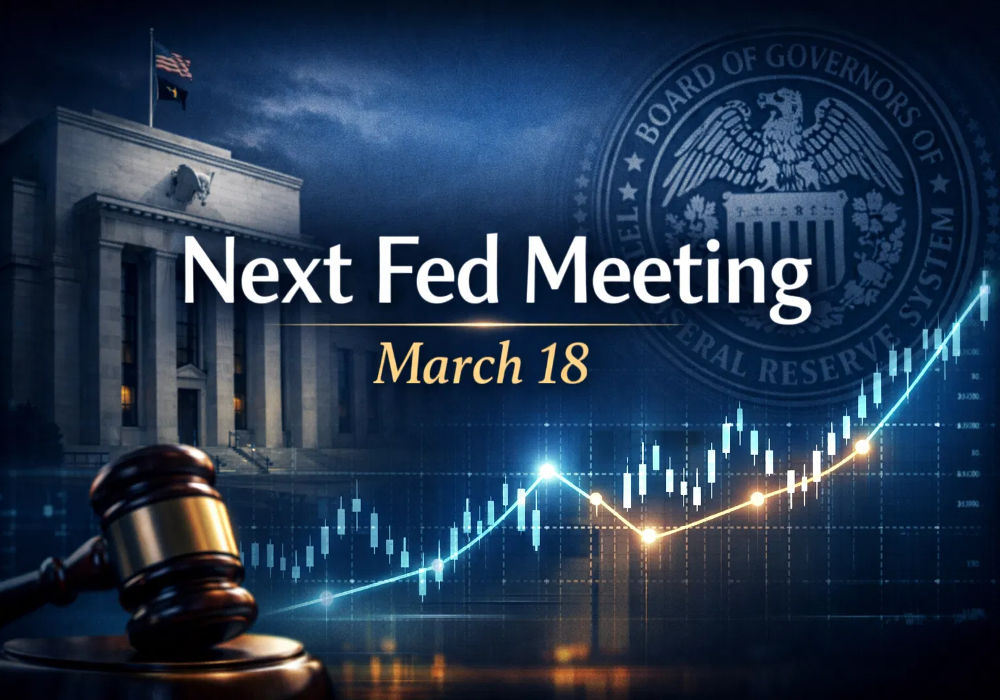
Federal Reserve meetings are among the most closely watched events in financial markets. As of today, March 19, 2026, the Federal Open Market Committee (FOMC) has just concluded its most significant gathering of the year so far. On March 18, the Fed held the benchmark interest rate steady at 3.50% to 3.75%, citing sticky inflation and a sensitive energy market.
The next fed meeting on interest rates is scheduled for April 28–29, 2026. While the Fed’s recent projections suggest at least one more rate cut may be on the table for 2026, officials have emphasized a cautious, data-driven path, particularly as the market absorbs the impact of ongoing global conflicts on fuel and goods pricing.
The Federal Reserve’s Federal Open Market Committee (FOMC) meets 8 times per year at roughly 6-week intervals. Each meeting produces either a rate change or a hold decision, followed by a press conference from the Fed Chair.
2024 FOMC Meeting Schedule
| Meeting Date | Decision Day | Press Conference |
|---|---|---|
| January 30-31 | January 31 | Yes |
| March 19-20 | March 20 | Yes |
| April 30-May 1 | May 1 | Yes |
| June 11-12 | June 12 | Yes |
| July 30-31 | July 31 | Yes |
| September 17-18 | September 18 | Yes |
| November 6-7 | November 7 | Yes |
| December 17-18 | December 18 | Yes |
*All meetings produce a statement; press conferences happen after every 2024 meeting (policy changed from quarterly in 2019).*
How to Follow the Decision in Real Time
| Platform | What to Watch |
|---|---|
| FederalReserve.gov | Official press release at 2:00 PM ET on decision day |
| CNBC/Bloomberg | Live coverage beginning before 2 PM |
| CME FedWatch Tool | Real-time market probability of rate outcomes |
| Twitter/X financial accounts | Instant reaction from analysts |
The most important moment is 2:00 PM Eastern on the second day – when the FOMC statement is released. Markets often move significantly in the minutes following.
What the Fed Actually Decides
The FOMC sets the federal funds rate target range – currently expressed as a range (e.g., 5.25%-5.50%). The decision is binary:
- Rate increase: Tighter monetary policy; reduces inflation but slows growth
- Rate cut: Looser policy; supports growth but may allow more inflation
- Hold: Keep rates unchanged; most common outcome in stable periods
How the Fed Telegraphs Decisions in Advance
The Fed works hard to minimize surprises – sudden unexpected decisions destabilize markets. The “communication toolkit”:
| Tool | What It Is | When Used |
|---|---|---|
| FOMC Statement | Post-meeting written statement | Every meeting |
| Dot Plot | Chart showing each official’s rate projections | Quarterly (March, June, Sep, Dec) |
| Fed Chair press conference | Q&A after every meeting | Every meeting since 2019 |
| Fed speeches | Individual officials speak between meetings | Ongoing |
| Jackson Hole Symposium | Annual economic conference; major speeches | August each year |
The dot plot is particularly watched – it shows where each of the 19 FOMC participants see rates heading over the next several years.
The CME FedWatch Tool – Market Probability
Between meetings, futures markets price in the probability of different rate outcomes. The CME FedWatch Tool translates this into percentages:
Example: “Markets are pricing in a 65% chance of a 25 basis point cut in September”
This is real money betting on outcomes – generally a better predictor than individual forecasters because it aggregates many views. You can find it at cmegroup.com/fedwatch.
How Fed Decisions Affect Your Financial Life
| Fed Decision | Effect on You | Timeline |
|---|---|---|
| Rate hike | Mortgage rates rise; HELOC rates rise immediately; savings rates rise; stock valuations under pressure | Days to weeks |
| Rate cut | Mortgage rates may fall; HELOC rates fall; savings rates fall; stocks often rally | Days to weeks |
| Hold | Status quo maintained | Immediate |
Important nuance: The 30-year mortgage rate doesn’t directly follow the fed funds rate – it follows the 10-year Treasury yield, which reflects long-term inflation expectations. Fed cuts don’t automatically lower mortgage rates.
What Analysts Expect for Upcoming Meetings
As of 2024, the general market expectation is:
- The Fed reached its terminal rate around 5.25-5.50%
- Rate cuts expected to begin in 2024, with pace and number debated
- Most forecasters expect 1-3 cuts in 2024 and additional cuts in 2025
- The pace depends critically on inflation data (CPI, PCE) and employment data
The Language to Watch in Fed Statements
Fed statement language is carefully parsed by markets:
| Phrase | What It Usually Signals |
|---|---|
| “Appropriate to maintain the target range” | Hold decision; status quo |
| “The Committee will carefully monitor” | Data-dependent; no preset course |
| “Additional policy firming” | More rate hikes possible |
| “Expects reductions in the target range will be appropriate” | Rate cuts coming |
| “Proceed carefully” | Cautious about cutting |
The change in specific words between statements – even subtle ones – moves markets.
Bottom Line
The next Fed meeting and its outcome matters to anyone with a mortgage, savings account, investments, or debt. The schedule is predictable – eight times per year, roughly every six weeks. The CME FedWatch tool gives you real-time market probabilities between meetings. And the 2:00 PM announcement on decision day, followed by the press conference, is when the information that moves markets arrives. For long-term investors and homeowners, understanding the direction of rates is more useful than predicting the exact timing of each move.