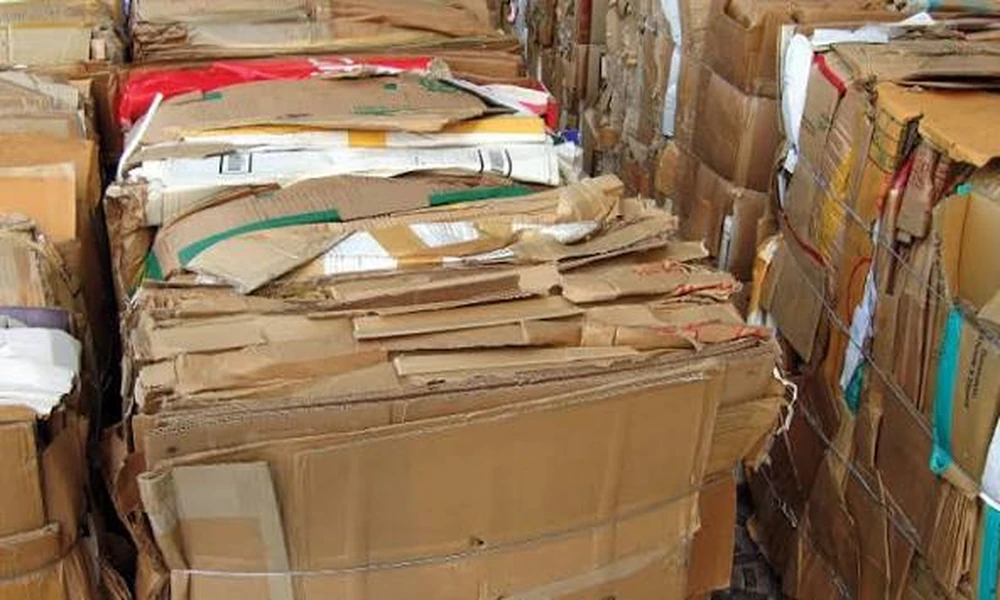
Every retail backroom, distribution centre and supermarket loading dock produces the same by-product: flattened shipping boxes. In the trade they are called old corrugated containers, or OCC, and they are one of the most collected materials in the waste stream. What happens after the baler is less visible. Most bales are sold to a paper mill that pulps them and turns the fiber back into linerboard and fluting for new boxes. That loop is old, efficient and largely invisible to the stores that start it.
Packaging producers, regional mills and large recyclers all face the same question: keep selling bales, or process them on site? This article looks at that decision from the operating side: what an OCC recycling line is, how output is sized, why bale grade sets the cleaning bill, and where fiber and margin leak away. Figures come from the US Environmental Protection Agency’s paper and paperboard data and from the published line ranges of Zejiang, a stock preparation and paper machine builder in Henan, China.
Why old corrugated containers are a feedstock market
According to the EPA, US municipal solid waste contained 67.4 million tons of paper and paperboard in 2018, and approximately 46 million tons were recycled, a rate of 68.2 percent. Corrugated boxes did far more: their recycling rate was 96.5 percent. In other words, almost every box that enters a store as packaging leaves it as raw material for somebody else.
That level of collection is good news for supply and harder news for price. When nearly all boxes are already recovered, a new processor competes for bales with existing mills rather than finding an untouched source. High recovery rates describe collection, not quality, and a market full of bales can still be short of clean bales.
What an OCC recycling line actually is
An OCC recycling line is the stock preparation half of a paper mill. Bales are broken into slurry in a pulper, wire, rope, tape and plastic are pulled out, high-density cleaners spin out sand and staples, pressure screens sort usable fiber from bundles, and the stock is thickened before it is fed to a paper machine. Each stage removes a different kind of waste. Zejiang describes six connected stages and builds these lines at 10 to 300 TPD from its Henan factory.
This is a different category from the shredders and balers sold to stores and offices. The same supplier warns buyers who compare prices against a small office shredder-baler unit or a school recycling kit that they are pricing the wrong equipment; those units handle kilograms, a mill line handles tonnes per hour.
Where it stops: a recycling line makes stock, not paper, so the business case only closes when a paper machine or a stock buyer is part of the plan.
Sizing output: from a single shift to an export mill
Capacity tiers follow the volume of bales a site can secure. At the small end, a 10-30 TPD line usually uses a single hydrapulper, 1-2 stage HD cleaning and one pressure screen line. Zejiang says it quotes most mills in the 30 to 100 TPD range, and it does not offer standard designs under 10 TPD because the cost of a full six-stage cascade is not justified at that scale. Lines of 100-300 TPD add drum pulpers, full cleaning cascades and multiple screen stages.
Most operators should size on secured bale supply, not on ambition. A line fed at half load costs nearly as much to run as a full one and recovers its investment far more slowly. Shift patterns matter too: two shifts on a smaller line can outperform one shift on a large one.
Where it stops: buying for future growth is reasonable for buildings and utilities, but oversized pulpers and screens simply burn power on stock that is not there.
Bale grades of old corrugated containers and the cleaning bill
Bales are traded by grade, and the grade limits how much non-paper material they may carry. Industry specifications cited on the OCC line page set the limits: standard OCC under ISRI PS 11 allows Max 5% Outthrows, while double-sorted OCC under PS 12 allows Max 2% Outthrows. Mixed unsorted paper has no fixed figure and needs a heavier cleaning cascade specified up front.
Contaminants that slip through have consequences far downstream. Some only show up weeks later. A length of baling wire that passes the detrashing stage can tear a wire section on the paper machine itself, and an undersized screen leaves shives that end up as customer complaints on finished rolls. Retailers and distributors who supply bales make them easier to sell by keeping plastic film and strapping out at source. Cleaner bales mean fewer stops.
Where it stops: paying a premium for double-sorted bales only makes sense if the line was designed around them; a line built for dirty stock will not return the difference.
Pulper choice and what it does to yield
Pulper choice sets the tone for the whole line. Large OCC bales float and spin in a round tub, which is why continuous lines use a D-shaped tub: the reference Type D continuous pulper runs at 4-6% consistency and 25-410 t/d. Dirtier OCC calls for a drum pulper: the same builder specifies one with 6 mm accept holes, which keeps trash in larger pieces so it can be removed rather than shredded into the fiber.
Choosing on motor size is the usual mistake. A rotor matched to the furnish defibers the board without tearing fibers that are already free, while a mismatched one either wastes power or pushes half-pulped flakes onward to block the screens. Rotor vanes are the main wear part and should be stocked on site.
Where it stops: no pulper compensates for wet-strength board from food and drink packaging, which needs its own treatment and should be kept out of plain OCC bales.
Water is the hidden volume
Stock leaving the pulper lands at 0.5-1.5% consistency, meaning 98-99.5% of what moves through the pipework is water, as the builder’s thickener page puts it. Pumps, chests and pipes are therefore sized for water, and thickeners exist to remove most of it again before the paper machine.
Site managers should treat the recycling line as much a water project as a machinery project. Fresh water supply, white water reuse and effluent treatment should be costed in the first feasibility study, not discovered at permit stage. Water also carries heat and chemicals, so every loop affects energy use.
Where it stops: water loops can be closed only so far before dissolved material builds up and starts to foul the sheet.
Why a brown line skips deinking
OCC usually becomes testliner, fluting or kraft liner, grades in which brightness does not matter. That allows the line to run as a brown line: no deinking stage, lower capital cost, and simpler water and sludge handling than a white-grade line built for tissue or printing paper. For most packaging producers, deinking would be capital spent on a property their customers never measure. Fewer stages also mean fewer pumps to maintain.
Where it stops: if the business plan later adds office waste and white grades, the thickening section should be laid out with space for deinking from day one.
Limits of fiber recovery and the margin
Every reject stream carries some good fiber out with the contaminants. Sand, staples and plastic never leave alone. Zejiang’s cleaner page points out that for a mill operating at 100+ tons per day, a 1-2% loss of fiber in the reject stage adds up very quickly, and that the loss is rarely measured until someone runs a fiber balance. Cascading cleaner stages, where rejects from one stage are diluted and cleaned again, recovers part of that fiber. Measuring the loss needs only sampling and a scale.
Quick arithmetic shows the stakes. On a 100 tons-per-day line, 1% of fiber is one tonne a day, which over a year of continuous running is more than 300 tonnes of purchased bales thrown away as reject.
Where it stops: each extra cleaning stage adds pumps, power and floor space, so recovery stages should be added until their cost meets the value of the fiber, not beyond.
What to settle before asking for a paper recycling plant quote
- Secured bale volume per day and the share by grade.
- Target product and basis weight, and who will buy the paper or stock.
- Whether the line ends in a paper machine on site or in sold pulp.
- Water source, discharge limits and space for effluent treatment.
- Reject handling: who takes plastics, wire and sludge, and at what cost.
- Power supply and operating shifts.
With those answers on paper, a supplier can size each stage instead of selling a catalogue item. Operators who want to see how capacity tiers, bale grades and stage counts are laid out together can read the line descriptions for the Zejiang paper recycling machine range before drafting their own enquiry. The boxes will keep coming either way; the business decision is whether their fiber value stays on site. Bales sold today are fiber someone else will turn into margin.